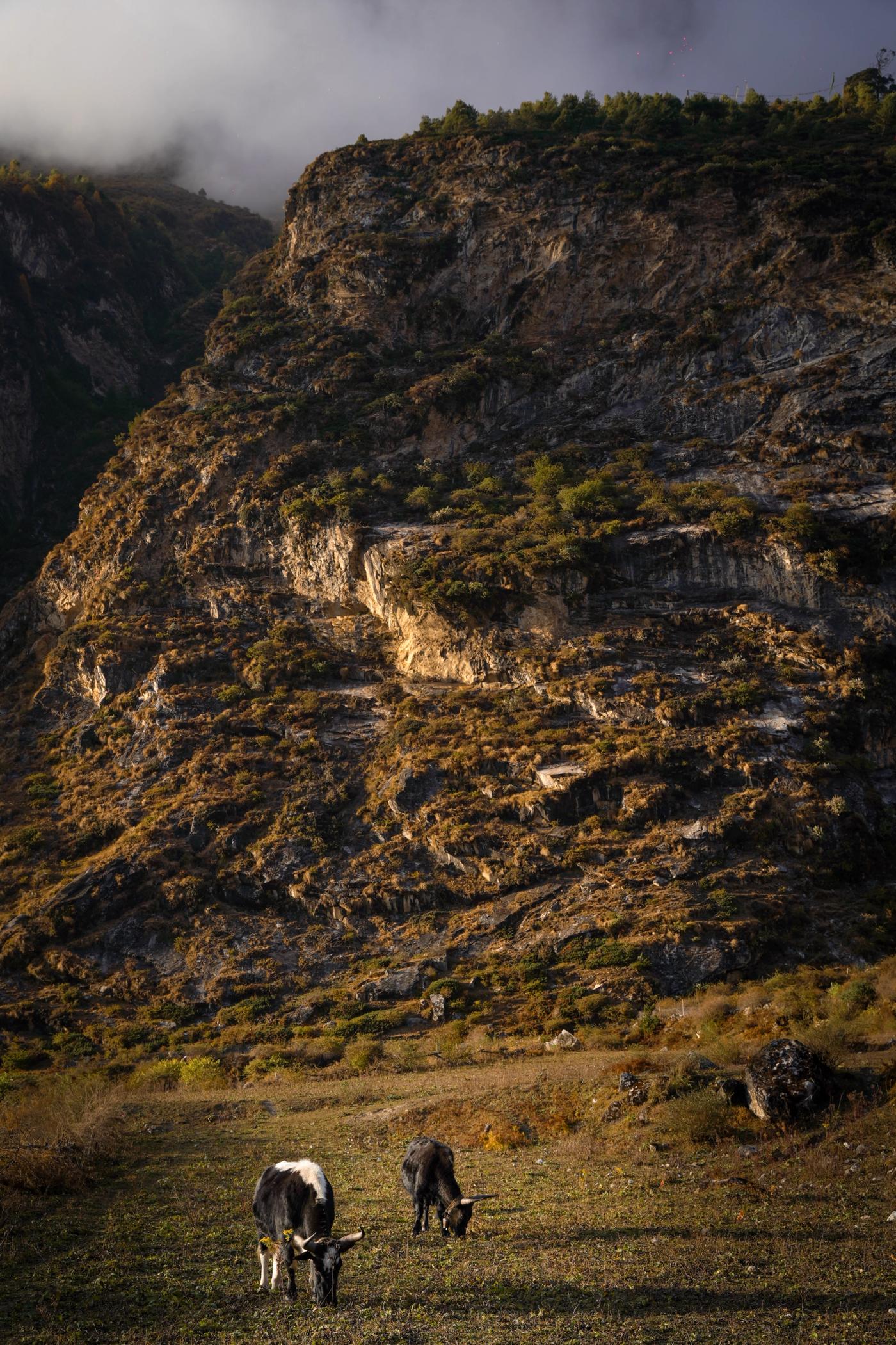
There is a valley in northern Nepal that does not appear on most tourist maps. It sits above the Budi Gandaki river, tucked behind a ridge that hides it from the main trekking trail, and it shares a border with Tibet that has kept it quietly closed to outsiders until 2008. Its name is Tsum, which means "vivid" in the Tibetan dialect spoken there. The people who live in it have had almost no reason to leave.
We reached the valley on the third day of walking from Soti Khola. The trail follows the Budi Gandaki gorge north — the same river that the Manaslu Circuit crosses further up — before turning sharply east into a side valley that the gorge seems designed to conceal. One moment you are on a rocky river path under a narrow sky. The next, the valley opens and you are standing in front of green terraced fields, mani walls older than most countries, and a horizon of white peaks that have no names in any guidebook.
The villages of Tsum — Chhekampar, Nile, Mu Gompa — sit between 3,000 and 3,700 metres. They are Buddhist, deeply so, in a way that has survived without the scaffolding of tourism. The monasteries are not maintained for visitors. The monks do not pose for photographs. The prayer flags are not decorative. Everything here is for the people who live here, and you are welcome to observe it, but the valley does not perform for you.
What strikes you first is the silence. Not the silence of altitude or emptiness, but the silence of a place that has its own interior life and does not need yours. Women weave on hand looms outside their stone houses. Children run between the houses without looking at you. Yaks graze on the upper slopes with the slow indifference of animals that have never been rushed.
The walk to Mu Gompa, the highest monastery in the valley at 3,700 metres, takes half a day from Nile. The path passes through a landscape that shifts from terraced agriculture to high alpine meadow in the space of an hour. The monastery itself is built into a cliff face, red and white and impossibly old-looking, with prayer wheels that spin in the wind without any human hand. A monk offered us butter tea and did not ask where we were from.
There are no luxury lodges in Tsum. There are teahouses — basic, warm, serving dal bhat twice a day. You sleep under heavy blankets and wake to the sound of bells. The electricity is solar. The wifi does not exist. Three days in Tsum is long enough to understand why the people who come here rarely talk about it. It is the kind of place you want to keep to yourself.
Getting there requires a Tsum Valley restricted area permit, a registered guide, and around nine to ten days of walking from the trailhead. It is not convenient, which is precisely why it remains what it is.