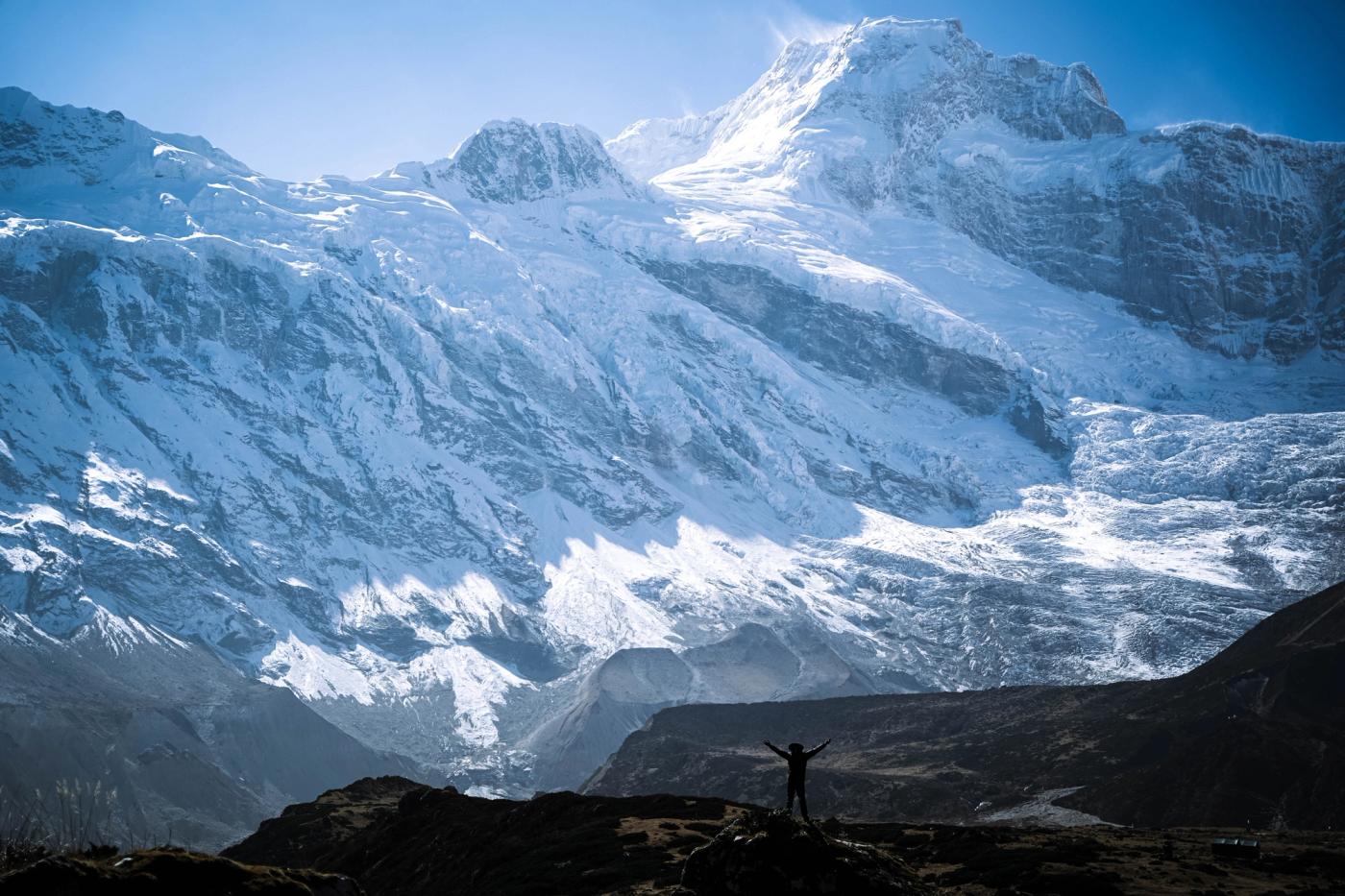
Most people who fly into Kathmandu and want to trek immediately think of Everest or Annapurna. This is understandable — both are exceptional — and it means that Langtang, which sits two hours north of the capital by road and offers Himalayan scenery as dramatic as anything in Nepal, remains quietly underused. On the Langtang trail you will walk for hours without meeting another foreign trekker. The teahouses will have your name if you call ahead. The views of Langtang Lirung, the 7,234-metre peak that frames the valley's northern end, will have no queue.
There is another reason to come here, beyond the logistics. Langtang has a story that the other trekking regions do not.
On the 25th of April 2015, the earthquake that killed nearly 9,000 people across Nepal triggered an avalanche that buried the village of Langtang in minutes. The village — the main hub of the trekking trail, home to around 350 people and dozens of trekkers and guides — was covered by a wall of ice, rock, and compressed air moving at several hundred kilometres per hour. Around 250 people were killed. Almost nothing remained.
The trail was reopened in 2016. The new village of Langtang — built slightly above the old site, the ruins of which are marked by a stone memorial wall — is constructed of the same stone and wood as the original but with a rawness that fresh construction carries. The people who rebuilt it are the same people who lost it. Many of them lost family members in the seconds it took the mountain to move.
Trekking to Langtang now is not a somber experience — the valley is too beautiful for that, and the teahouse owners are too warm. But it carries a weight that the more heavily touristed routes do not, and that weight is valuable. It is a reminder that the mountains you are walking toward are genuinely powerful and that the people who live beneath them know this in ways that visitors can only begin to understand.
The trek itself is excellent by any measure. From Syabrubesi, reached by bus or jeep from Kathmandu, the trail climbs the Langtang river valley through subtropical forest, then rhododendron and bamboo, then high alpine meadow. By day three you are at Kyanjin Gompa, a monastery settlement at 3,870 metres with a small cheese factory — the yak cheese is exceptional — and a view of the Langtang glacier that justifies every uphill step.
The optional climb to Kyanjin Ri, a viewpoint above the monastery at 4,773 metres, adds half a day and produces one of the finest panoramas in the Nepali Himalaya: Langtang Lirung directly north, the Jugal and Rolwaling ranges to the east, and on clear days the white dome of Shishapangma visible across the Tibetan border.
Return via the same route or continue to Gosaikunda — a sacred high-altitude lake at 4,380 metres, a pilgrimage site for both Hindus and Buddhists — and descend via Helambu to Kathmandu. The extended route adds three to four days and passes through landscapes that feel entirely different from the main valley.
Langtang is the trek you recommend to someone who wants to understand Nepal rather than simply tick it off. Come with time, come with attention, and read about the earthquake before you arrive. The valley will mean more.