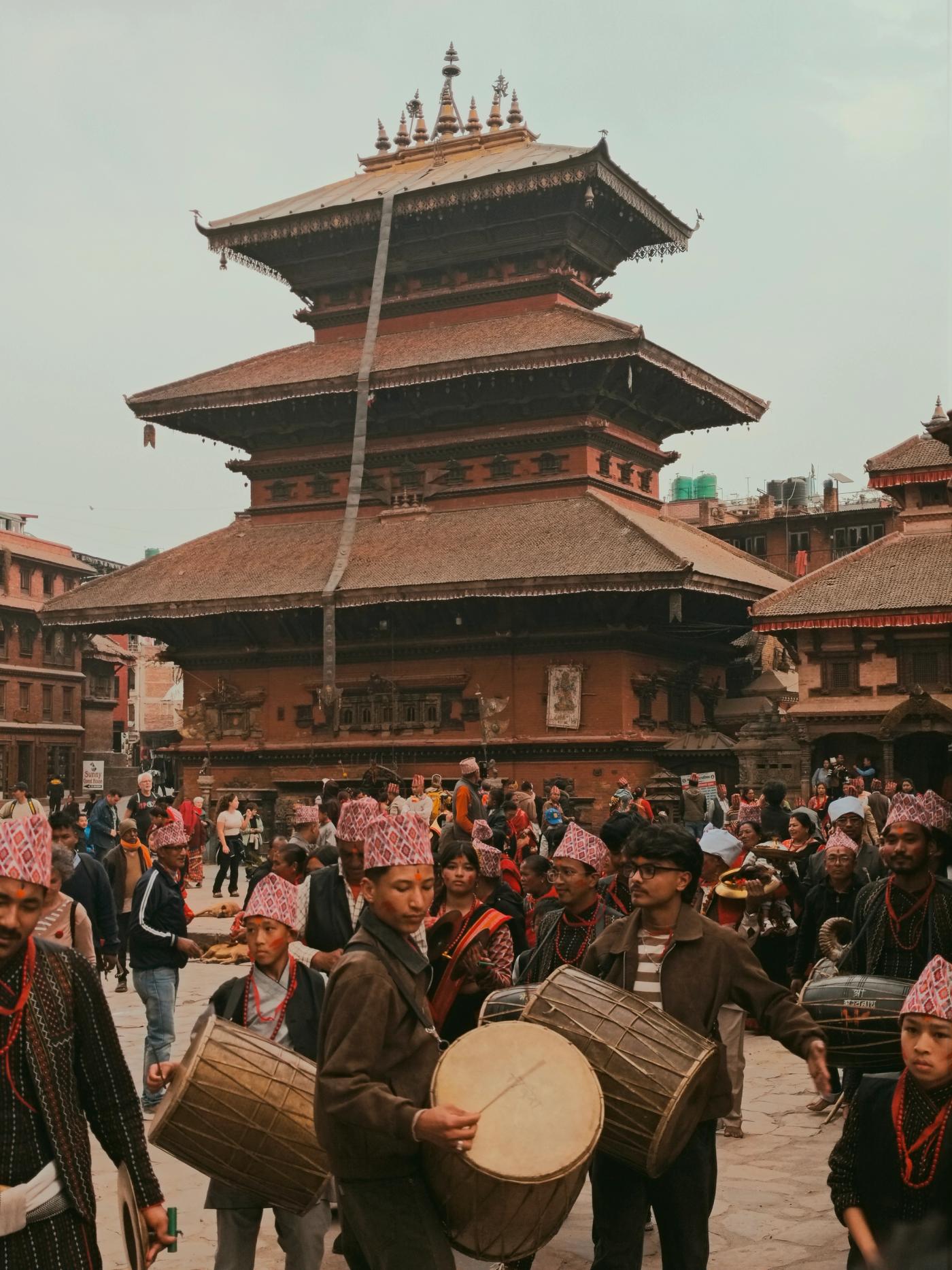
On an evening in late September, the old city of Kathmandu does something no other city on earth does. It stops moving. The streets — normally a continuous argument between motorcycles, pedestrians, dogs, and vegetable sellers — empty of traffic and fill instead with tens of thousands of people pressing toward Durbar Square. Somewhere in the square, behind a carved wooden window that she almost never opens, a girl is preparing to be seen.
She is the Kumari. She is between five and eleven years old, depending on the year. She has been selected from the Newar community's Shakya clan through a process that involves examining 32 physical attributes, assessing her reaction to a series of ritual tests, and consulting the stars. Once chosen, she leaves her family home and moves into the Kumari Ghar, the palace beside Durbar Square that has been her residence — and will continue to be — until she reaches puberty and her divinity passes to another girl.
On the night of Indra Jatra, she comes out.
Indra Jatra is an eight-day festival that honours Indra, the king of the gods, and commemorates a Newar legend involving his capture and release by the people of Kathmandu. It involves the raising of a ceremonial pole, masked dances, the distribution of rice beer from the mouth of a carved deity called Swet Bhairav, and the Kumari's procession. Of these, the procession is what the city has come for.
The Kumari is carried in a wooden chariot — painted red and gold, three storeys high, pulled by ropes held by dozens of men — through a prescribed route through old Kathmandu. She does not walk. Her feet must not touch the ground in public. She sits behind a carved wooden screen at the top of the chariot, her eyes lined dark with kohl, her forehead marked with the third eye, wearing a crown of red silk and gold. She does not smile. The divine do not reassure you with expressions.
The crowd presses close to the chariot but does not touch it. Offerings are placed at its base. Men with drums and cymbals walk alongside. The air smells of incense and marigold and the specific exhaust of ten thousand motorcycles that have been rerouted several streets away.
Watching the Kumari pass, what you feel is not the comfortable warmth of a cultural performance. It is something closer to vertigo — the recognition that you are standing inside a tradition that is genuinely, actively alive. The people around you are not watching a re-enactment. They believe what they are watching. The little girl in the chariot, who was a schoolchild last year and will be a schoolchild again in a few years, is, for this moment, a goddess. The city has organised itself around that fact.
If you plan to witness Indra Jatra, arrive early. The procession begins after dark and the square fills quickly. Stand on the north side of Durbar Square for the best view of the chariot's path. Dress modestly. Do not push toward the chariot. Bring patience — the procession moves slowly and stops often for ritual observances. And understand that what you are watching is not for you. You are a guest at something that would happen whether you were there or not.
That is the feeling to hold onto.